
Disclaimer and content warning
This article discusses domestic and family violence, coercive control, homicide, police responses and court processes. It is provided for public education and advocacy only and is not legal advice. Laws and procedures differ across Australia.
If you are in immediate danger, call 000.
For confidential support, contact 1800RESPECT on 1800 737 732, text 0458 737 732, or use its online services.
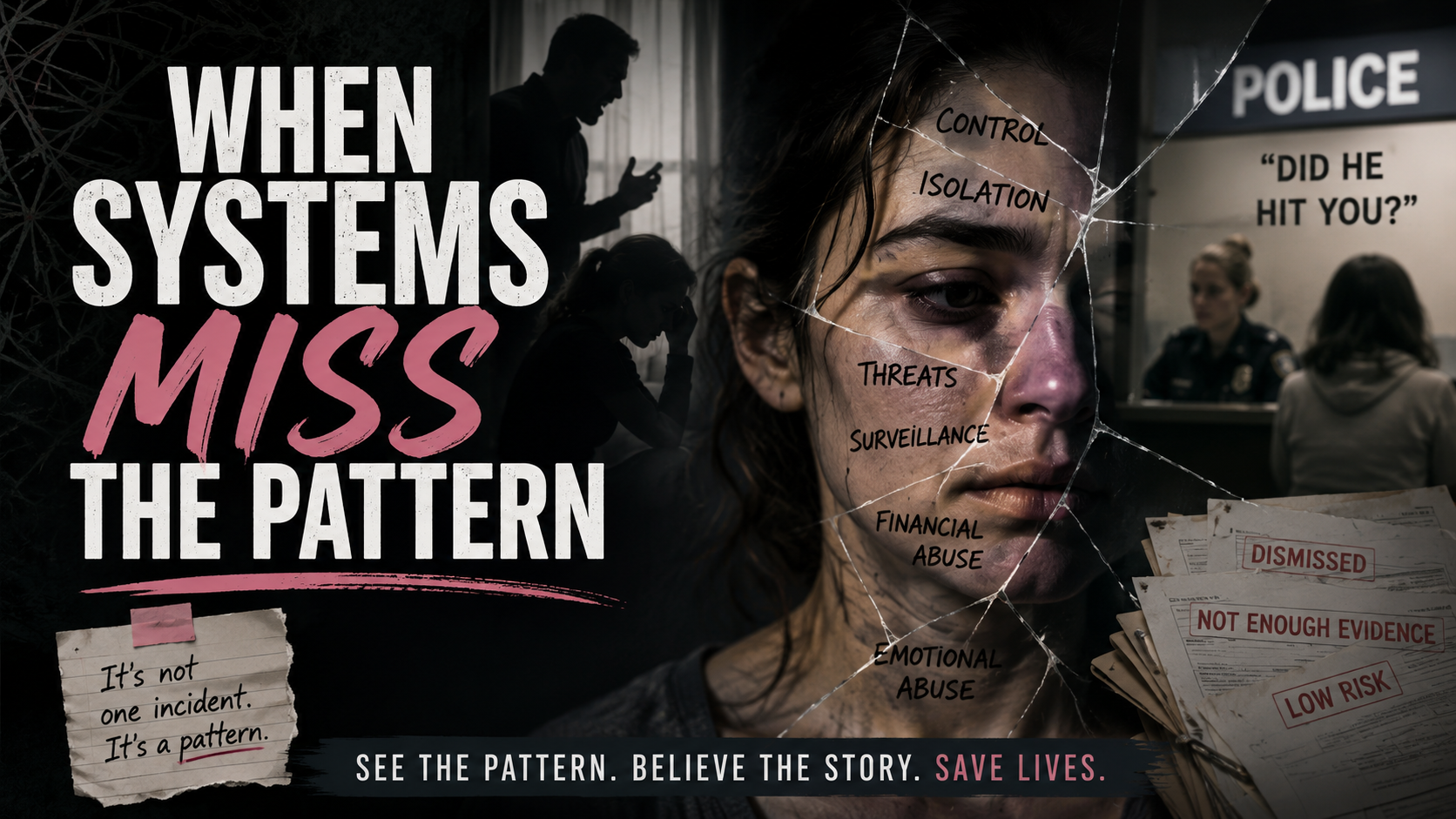
Beyond “Did He Hit You?”: When Systems Miss the Pattern
“Did he hit you?”
It sounds like a straightforward question. In a domestic violence report, however, it can become a dangerously narrow one.
A woman may answer no while living under surveillance, financial restriction, intimidation, sexual coercion, stalking, threats, isolation and fear. She may be living inside a pattern designed to remove her independence without leaving a visible bruise.
Coercive control is not one incident. It is a persistent pattern of behaviours used to dominate, control and isolate another person. It can be as harmful as physical violence even when no physical injury is visible.
When police, lawyers and judicial officers focus only on whether a physical assault occurred on a particular day, they may miss the larger story. They may record an argument rather than a campaign of control, interpret trauma as inconsistency and underestimate escalating risk.

The wrong question shrinks the story
The better question is not only, “Did he hit you?”
It is, “What pattern have you been living inside?”
Has he threatened you, your children, pets or himself? Does he monitor your phone, movements or money? Has he strangled, stalked, sexually coerced or punished you? Has the behaviour escalated since separation? Does he use
parenting arrangements, police reports or court processes to maintain contact and control?
Australian research describes coercive control as a pattern that may include physical, sexual, emotional, psychological and financial abuse, together with stalking, surveillance, isolation, intimidation, technology-facilitated abuse and systems abuse.
A response that searches only for physical injuries can fail to recognise the nature of the danger being reported.
Reporting is often a last resort
Women do not usually enter a police station carrying a perfectly ordered file, a calm voice and a legally precise description of years of abuse.
They may be exhausted, frightened, ashamed or confused. They may minimise what happened because minimising became a survival strategy. They may remember events out of sequence, still love the person harming them, or fear losing their children, home, income or life.
A report may be the first time a woman has tried to explain an experience that was deliberately made difficult to explain.
The 2022 Queensland Commission of Inquiry into police responses to domestic and family violence heard from more than 1,200 victim-survivors. Women described being discouraged from reporting, disbelieved, blamed and dismissed, particularly when there were no visible signs of physical violence or they did not fit the stereotype of an “ideal victim.”
The Commission also heard that poor police responses made some victim-survivors reluctant to seek police assistance again.
When a woman has overcome fear and conditioning to ask for help, a dismissive response may close the door she struggled to open.
Hannah Clarke and the warnings already present
Hannah Clarke and her children, Aaliyah, Laianah and Trey, were murdered by Rowan Baxter in Brisbane in February 2020.
Their deaths were not preceded by an absence of warning signs.
The coronial findings documented controlling behaviour, post-separation escalation, domestic violence proceedings and Hannah’s genuine fear for herself and her children. The inquest found there were missed opportunities to hold Baxter accountable, including the handling of an assault and a breach of a domestic violence order.
The coroner recognised that Hannah’s fears were realistic and ultimately confirmed in the worst possible way.
Hannah should not be reduced to a lesson delivered after her death. Her experience demands action before the funeral, not reflection after it.
A protection order can provide reassurance, but a document cannot physically restrain a determined perpetrator.
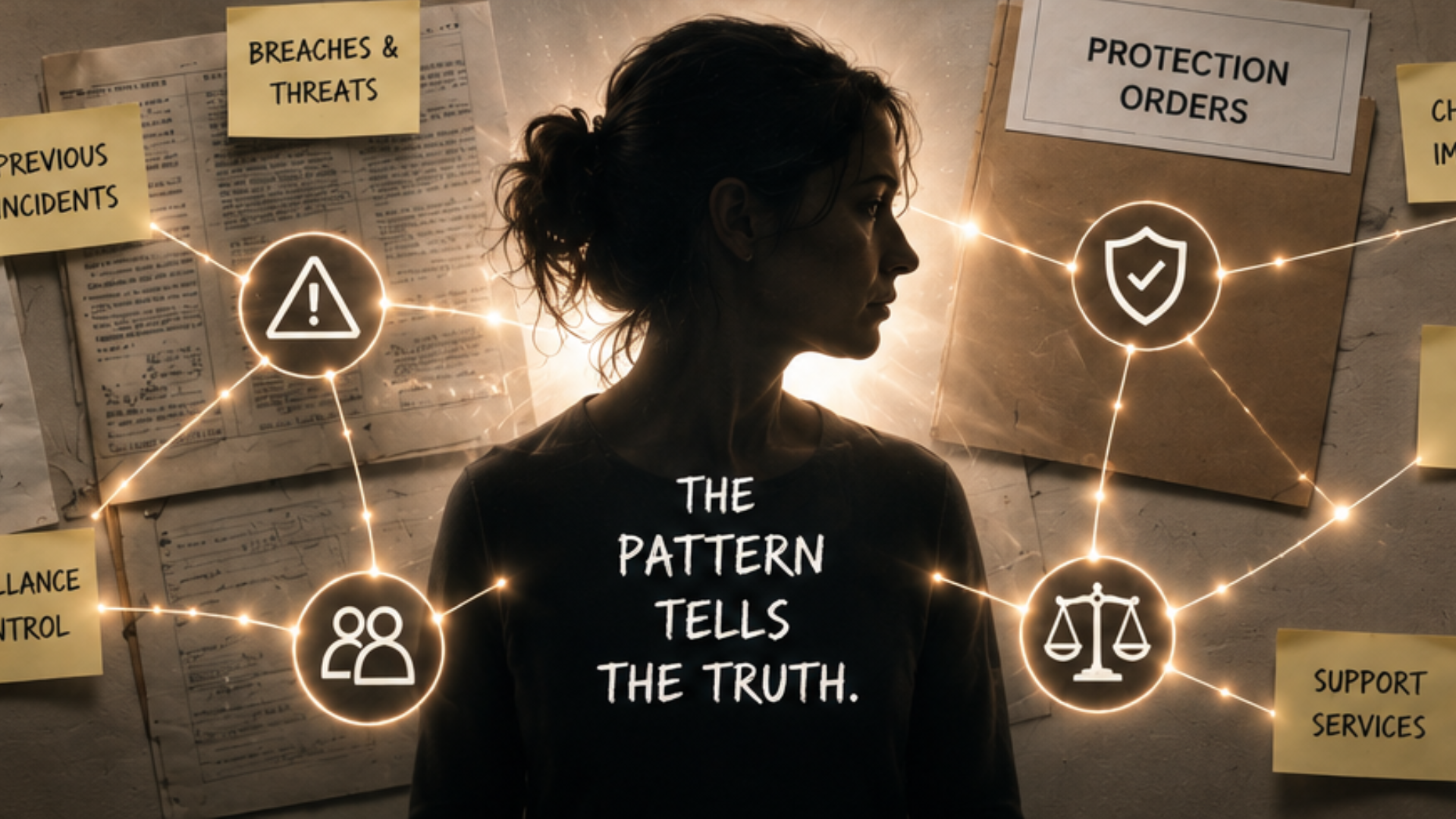
Police and courts must examine breaches, threats, stalking, strangulation, sexual violence, access to weapons and post-separation control as interconnected evidence of risk.
Police must investigate patterns, not snapshots
Police are often the first formal system a victim-survivor encounters. Their questions, records and decisions can shape everything that follows.
A strong police response must document the history of the behaviour, not only the latest incident. Officers need access to previous reports, protection orders, criminal histories and relevant intelligence.
They must also understand that calm presentation does not prove innocence, while distress does not prove aggression.
Perpetrators can appear reasonable, persuasive and cooperative. Victim-survivors may appear angry, confused or resistant after prolonged abuse. Without specialist understanding, police can mistake presentation for power.
The Queensland Commission of Inquiry identified incident-based responses that failed to consider broader patterns of violence. It also documented cases in which victim-survivors were misidentified as perpetrators, including an instance where police failed to examine the alleged perpetrator’s extensive history.
Training must therefore be practical, repeated and accountable. It must cover coercive control, trauma, strangulation, stalking, post-separation risk, systems abuse and the correct identification of the person most in need of protection.
The Hannah Clarke inquest recommended urgent face-to-face domestic violence training for specialist police officers and mandatory training for all officers.
The judiciary must see the whole case
The same pattern-based approach is required in court.
A magistrate may see an application, a breach, a bail decision or a cross-application as a separate legal event. For the victim-survivor, it may be one part of a continuing campaign of control.
Systems abuse can include repeated applications, complaints and proceedings designed to exhaust a victim-survivor financially and emotionally, prolong contact, undermine her credibility or interfere with parenting and protection matters.
Judicial officers need the knowledge and information required to identify coercive control. Recognised warning signs include isolation, monitoring, economic abuse, threats, strangulation, harassment, disputes involving children and attempts to control court hearings.
Bail, sentencing and protection-order decisions should be informed by the full history of the relationship and the possibility of escalation.
ANROWS has called for improved police guidance on identifying patterns of coercive control and clearer guidance for magistrates dealing with inappropriate or competing applications.
A legal system that separates every incident from the behaviour surrounding it may never see the full level of danger.
When systems misidentify the victim
Misidentification is not a minor administrative error.
A victim-survivor wrongly named as the respondent may lose access to support services, face criminal charges, struggle in parenting proceedings and become more vulnerable to the person abusing her.
The perpetrator may then use the incorrect order to threaten further reports, discredit her or present himself as the victim.
This risk is particularly serious for First Nations women, women with disability, culturally diverse women and women whose trauma, mental health or substance use affects how they communicate or present to authorities.
A traumatised person may be angry. She may be frightened, distrustful, withdrawn or unable to provide a clear chronological account. None of those reactions establishes who holds the power or who presents the greater danger.
The task is not to search for a perfect victim.
The task is to identify power, fear, pattern, intent and risk.
What a safer response requires
A safer system begins by recognising that lived experience contains evidence.
This does not mean abandoning due process. It means conducting proper investigations instead of demanding that frightened people prove the entire case at the police counter.
It means asking about the pattern.
It means recording disclosures accurately, checking previous reports, taking breaches seriously, connecting victim-survivors with specialist support, explaining decisions and correcting misidentification quickly.
It means holding perpetrators accountable for repeated conduct rather than waiting for a catastrophic incident.
Information sharing between police, courts, child protection agencies and specialist services can improve risk assessment, reduce the trauma of repeated retelling and enable earlier action when danger is identified.
Lived experience must shape reform
Victim-survivors know where systems break because they have lived through the gaps.
Their stories should not be collected as emotional additions to decisions that have already been made. Lived experience should shape police training, risk-assessment tools, court practice, information sharing, complaint processes and accountability measures from the beginning.
The Australian National Principles to Address Coercive Control include lived experience in policy and practice and call for better legal and community responses.
That commitment must become visible at the moment a woman asks for help.
“Did he hit you?” may establish one fact.
It cannot establish the whole truth.
The question that may save a life is:
“What has he been doing to make you afraid, and what does the pattern tell us about what he may do next?”
Women should not have to arrive bruised, strangled or dead before the system recognises they were in danger.
#DomesticViolence, #CoerciveControl, #VictimSurvivors, #PoliceResponse, #JusticeSystem, #HannahClarke, #SystemsAbuse, #LivedExperience, #SurvivorAdvocacy, #HealingThroughLove


