
Dear Prime Minister Albanese,
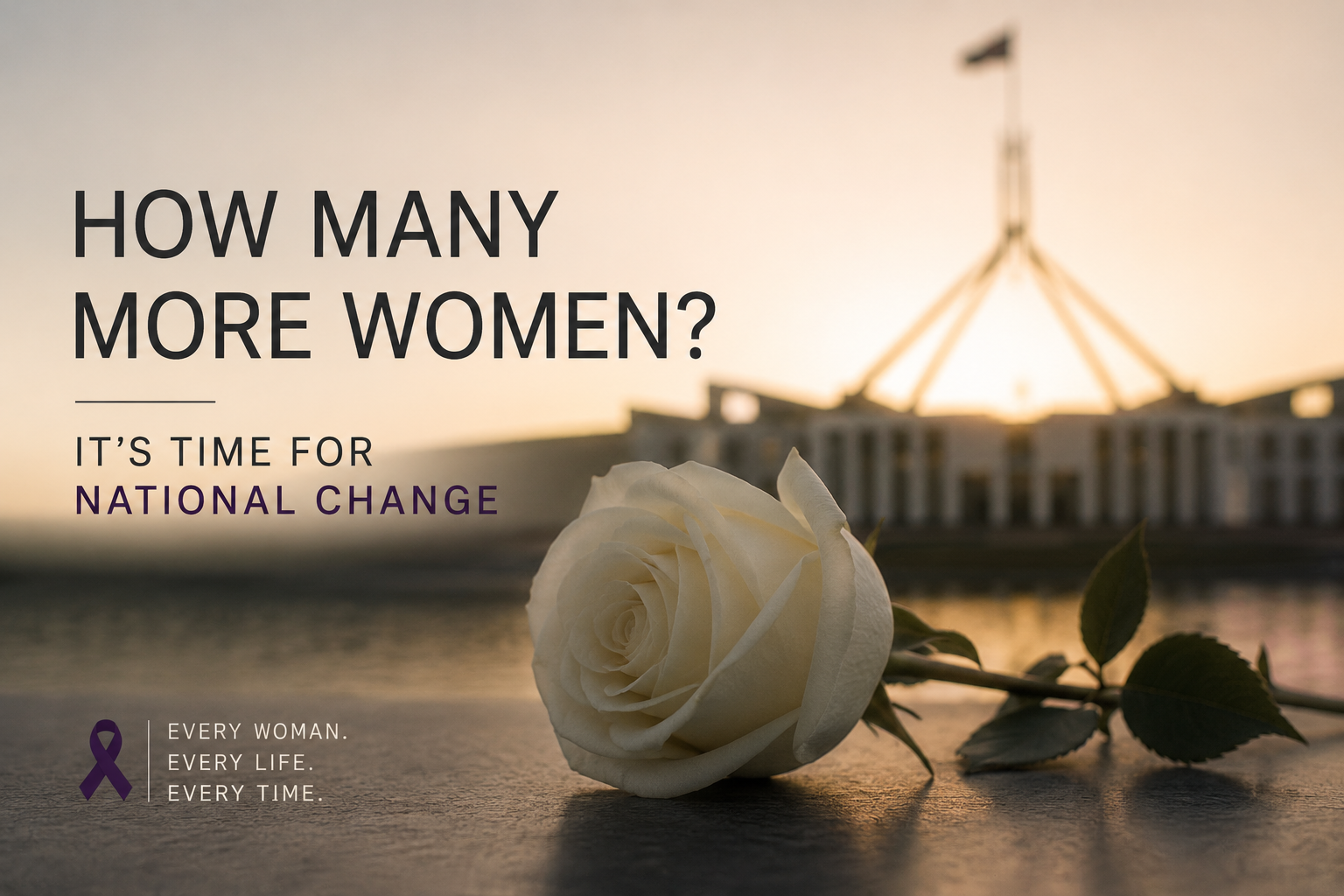
How many more women have to die before Australia decides that what we’re doing isn’t enough?
Not another announcement.
Not another consultation.
Not another promise that violence against women is a national priority.
Actual change.
I write this as a domestic and family violence advocate, but also as a woman with lived experience.
I know domestic violence isn’t a statistic.
Behind every number is a person. A family. Children. Friends. A life that should still be here.
The Australian Institute of Criminology has recorded 1,773 female victims of intimate partner homicide in Australia between 1 July 1989 and 31 March 2026.
One thousand, seven hundred and seventy-three women.
We cannot keep treating these deaths as unrelated tragedies.
When women are being killed by current or former partners, and when coercive control, threats, stalking, breaches of protection orders and escalating violence can precede homicide, we have to ask a difficult question:
Are the systems designed to protect victims doing enough?
The Australian Institute of Health and Welfare says domestic and family homicides rarely occur without warning. In many cases, identifiable risk factors and repeated episodes of abuse occurred before the homicide.
That’s the part I cannot accept.
The warnings are often there.
And yet women are still dying.
A national crisis requires national leadership
Prime Minister, I acknowledge that your Government has acted.
National Cabinet has described gender-based violence as a national crisis and agreed to strengthen responses to high-risk perpetrators, improve information sharing across jurisdictions, develop national risk assessment principles and trial focused deterrence models and Domestic Violence Threat Assessment Centres.
Those measures matter.
But announcements, programs and funding don’t remove the gaps that still exist between our jurisdictions.
Australia remains a federation in which criminal law, bail, sentencing, policing and many domestic violence laws are primarily the responsibility of states and territories.
I understand that you cannot simply stand in Federal Parliament tomorrow and rewrite every state sentencing law.
But you can lead.
You can bring every Premier and Chief Minister to the National Cabinet table and ask them to agree that a person’s protection from domestic violence shouldn’t depend on which side of a state border they live on.
You can push for nationally consistent approaches to high-risk and repeat domestic violence offending.
You can push for national best-practice principles around bail and sentencing where there is a demonstrated pattern of serious domestic and family violence.
You can demand stronger responses to repeated breaches of protection orders.
You can ensure police and courts have timely access to relevant information about serious domestic violence histories wherever in Australia those offences occurred.
And where somebody has been assessed as presenting an extremely high risk of serious or lethal violence, you can lead a national conversation about appropriate restrictions and monitoring.
That should include nationally consistent approaches to firearms and weapons restrictions, enforceable monitoring conditions where legally appropriate, strong responses to repeated breaches of protection orders and properly resourced specialist perpetrator-risk teams.
Australia is already developing a National Firearms Register that will give frontline police near real-time information about firearms, firearm owners and licences across jurisdictions. It is expected to be operational by mid-2028.
That demonstrates what is possible when Australian governments decide jurisdictional borders shouldn’t stand in the way of public safety.
So why can’t we show the same national determination when it comes to domestic violence?
There is another preventative measure Australia should adopt nationally.
A National Domestic Violence Disclosure Scheme.
Why should someone entering a relationship have no way of discovering that the person they’re becoming involved with has a documented history of serious domestic violence?
Why should that information remain hidden until they become another victim?
South Australia already operates a Domestic Violence Disclosure Scheme. It allows someone who feels unsafe to seek information about a current or former partner. An application can also be made by someone concerned about another person’s safety.
My question is simple:
Why should that protection depend on where you live?
I am asking your Government to work with states and territories to develop a nationally consistent Domestic Violence Disclosure Scheme available to Australians regardless of postcode.
It should include a carefully regulated right to ask, allowing someone with concerns about a current or prospective partner to request relevant information about a documented history of serious domestic and family violence.
It should also examine an appropriate right to know, allowing police in clearly defined high-risk circumstances, and subject to appropriate legal safeguards, to proactively warn someone when available information indicates they may be at serious risk.
This isn’t about publishing people’s criminal records.
It isn’t about creating a website where anyone can search anybody’s name.
It’s about prevention.
It’s about giving someone information that could help them recognise danger, seek specialist advice, create a safety plan or make an informed decision about whether to remain in a relationship.
And any disclosure must be accompanied by specialist domestic violence support, appropriate privacy protections and risk assessment.
A disclosure without support could leave someone frightened, vulnerable and unsure what to do next.
We talk constantly about early intervention.
This is early intervention.
No disclosure scheme will prevent every act of domestic violence.
But if information already held by authorities can help someone understand the danger they’re facing before violence escalates, surely that deserves national action.
Alongside a disclosure scheme, Australia needs another safeguard.
A secure National Domestic Violence Perpetrator Register.
A person with a documented history of serious or repeated domestic violence shouldn’t be able to cross a state border and leave that history behind.
They shouldn’t be able to move from Tasmania to Victoria, Victoria to Queensland, or anywhere else in Australia, while police, courts or relevant authorities are unaware of a serious pattern of behaviour recorded elsewhere.
Domestic violence doesn’t stop at state borders.
Neither should our knowledge of perpetrators.
Australia already has some of the infrastructure needed.
Domestic violence orders issued from 25 November 2017 are automatically recognised and enforceable throughout Australia.
The National Criminal Intelligence System also provides law enforcement and intelligence agencies with near real-time access to information from multiple jurisdictions, including domestic and family violence orders, incident and offence histories, warnings and warrants.
National Cabinet has already agreed to enhance that system with a warning flag to help police identify high-risk perpetrators.
So the foundations exist.
Now finish the work.
Whether delivered through a dedicated register or an expanded integrated national system, Australia needs a nationally consistent mechanism for identifying high-risk, repeat and serious domestic violence perpetrators.
Authorised police, courts and relevant agencies should be able to immediately identify a documented pattern of serious domestic and family violence regardless of where in Australia that behaviour occurred.
Such a system could include legally appropriate information concerning serious convictions, repeat offending, breaches of protection orders, relevant court orders and established high-risk assessments.
It should have strict eligibility criteria, privacy protections, review mechanisms and legal safeguards.
This shouldn’t be a public name-and-shame list.
The purpose isn’t humiliation.
The purpose is prevention.
Because perpetrators can move.
Their histories shouldn’t disappear when they do.
A police officer responding to an incident in Hobart should be able to know that the person standing in front of them has a serious domestic violence history in Melbourne.
A magistrate considering bail in Brisbane should have access to relevant information about serious or repeated domestic violence offending in Sydney.
Authorities assessing the safety of a new partner shouldn’t discover months or years later that another jurisdiction already knew this person presented a serious risk.
That information could change a decision.
It could change a risk assessment.
It could change bail conditions.
It could change the protection offered to a victim.
It could save a life.
A national perpetrator register or equivalent national information system should work hand in hand with a National Domestic Violence Disclosure Scheme.
One ensures authorities can see the pattern.
The other gives someone potentially at risk a carefully controlled way to access information that may help them protect themselves.
Because domestic violence is often a pattern, not an isolated incident.
If somebody repeatedly uses violence, coercive control, stalking, intimidation or threats against intimate partners, we cannot keep allowing each new incident, each new relationship and each new jurisdiction to be treated as though we’re starting from zero.
We aren’t.
There is a history.
There is a pattern.
And when that pattern demonstrates serious risk, the system needs to recognise it.
A perpetrator shouldn’t be able to find another victim simply by finding a new postcode.
Accountability must be part of prevention
Prime Minister, I am not asking for punishment for punishment’s sake.
Nor am I suggesting that harsher sentences alone will end domestic and family violence.
They won’t.
Prevention matters.
Early intervention matters.
Safe housing matters.
Specialist domestic violence services matter.
Children’s services matter.
Police training matters.
Behaviour-change programs matter.
Education matters.
But accountability matters too.
A protection order cannot simply become a piece of paper.
A breach cannot be treated as an administrative inconvenience.
A pattern of escalating behaviour cannot continually be viewed as a series of isolated incidents.
And a victim shouldn’t have to become a homicide statistic before the seriousness of the perpetrator’s behaviour is finally recognised.
Your Government has called gender-based violence a national crisis.
Then govern it like one.
What I am asking you to take to National Cabinet
Prime Minister, I am asking you to lead national action on five areas:
- Nationally consistent justice principles for serious and repeat domestic violence offending
Work with states and territories towards best-practice principles for bail, sentencing, protection-order breaches and judicial responses where there is an established pattern of domestic and family violence.
- Stronger nationally consistent restrictions for high-risk perpetrators
Develop best-practice approaches to firearms and weapons restrictions, monitoring, risk assessment and intervention where someone presents an established high risk of serious or lethal violence.
- A National Domestic Violence Disclosure Scheme
Give people throughout Australia access to a carefully regulated mechanism to obtain relevant information about a current or prospective partner where there are legitimate concerns about domestic violence.
- A secure National Domestic Violence Perpetrator Register
Create, or expand existing infrastructure into, a nationally consistent system that ensures serious domestic violence histories and established risk information can be identified by authorised agencies across state and territory borders.
- Accelerated national information sharing
Make sure police, courts and relevant agencies can see the patterns that matter when they’re making decisions about victim safety, protection orders, bail and perpetrator risk.
Then tell Australians what happens next.
Give us a timetable.
Publish the progress.
Tell us what National Cabinet agrees to.
Tell us where jurisdictions aren’t meeting national best practice.
And measure whether these reforms are actually protecting people and saving lives.
How many more?
When another woman is killed, don’t simply ask what went wrong in that individual case.
Ask whether the system recognised the danger early enough.
Ask whether information was shared.
Ask whether previous breaches were taken seriously.
Ask whether there was an escalating pattern.
Ask whether the perpetrator should have been subject to greater restrictions.
Ask whether the victim could have been warned.
Ask whether her death could have been prevented.
Prime Minister, women aren’t asking governments to promise that violence will end tomorrow.
We’re asking you to demonstrate the urgency that a national crisis demands.
We shouldn’t have to wait until another woman is killed before domestic and family violence dominates the headlines for a few days.
We shouldn’t have to march carrying photographs of dead women to prove that this matters.
And we shouldn’t have to keep asking:
How many more?
Australia has the knowledge.
We have decades of research.
We have inquiries.
We have recommendations.
We have data.
We have frontline expertise.
And we have the voices of victim-survivors and families who know exactly what happens when systems fail.
What we need is the political will to turn that knowledge into nationally consistent action.
Prime Minister, please use the authority and influence of your office to bring Australia’s governments together and make that happen.
Because the next woman who dies won’t be a statistic.
She’ll be someone’s daughter.
Someone’s mother.
Someone’s sister.
Someone’s friend.
And she should have had the right to be safe.
Rose Davidson
Domestic & Family Violence Advocate
Co-founder, Healing Through Love™
#HealingThroughLove, #DomesticViolence, #FamilyViolence, #Femicide, #ViolenceAgainstWomen, #CoerciveControl, #EndViolenceAgainstWomen, #DomesticViolenceAwareness, #SurvivorAdvocacy, #NationalReform



Just brilliant !!
I have been a victim of domestic abuse
We may find a level of healing but it never leaves us
I was beaten so badly i lay in a semi coma for 5 days before I could get help
My life now is dedicated to helping people find joy when it seems there is none